
Back to Projects
Project 07 / 14

Project 07 · Game

The Merging Thief

A stealth puzzle game where a thief catches police from behind, absorbs them and grows stronger.

  • Hyper-Casual
  • Puzzle
  • Mobile
  • Games
Genre:
Stealth Puzzle, Hyper-Casual
Scope:
Game Design · Level Design · UX/UI · 3D & Materials · Game Feel
Development Time:
1 Week
Team Size:
2
Tools:
Unity
The Merging Thief gameplay
0:00 0:00

Project Resume

Project resume

01

Overview

A hyper-casual stealth puzzle game. A thief sneaks behind police to merge with them, grows stronger and changes color to break through each level and reach the exit.

  • Platform Mobile (Android)
  • Team Size 2
  • Duration 1 Week
  • Engine Unity

Key Features

  • Sneak past vision cones and catch police from behind
  • Merge with police to double your level and change color
  • Walls, boxes and doors that ask for the right color
  • Buttons, lasers, keys and locks that build each puzzle
  • Lockers to hide in while a patrol walks by
  • Ten top-down levels, each on one vertical screen

My Role

Game Designer & Unity Artist

Owned the game, coordinated the programmer and made everything outside the code, from the ten levels to the art, VFX, UI and ads.

  • Designed all ten levels, the puzzles and the police routes
  • Built the 3D, animation, materials, VFX and UI in Unity
  • Created the Unity pipeline I used for the next year

  • Game Design
  • Level Design
  • UX/UI
  • 3D & Materials
  • Animation & VFX
  • Game Feel
02

Design Brief

The publisher liked to make alternative versions of its own hit games and test them with analytics, to see if a new take could repeat the original's success. The Merging Thief was one of them, a hyper-casual puzzle game about a thief and the police, built as a test demo in one week by a programmer and me.

Constraints

  • A new take on a hitAn alternative version of a game that had already worked for the publisher.
  • One weekFrom the first level to a playable test demo in one week, with one programmer.
  • One vertical screenA mobile game in portrait, with the whole level visible from above.
  • Easy to pick upA hyper-casual game anyone can understand without a tutorial.
03

Design Goal

I wanted every level to read at a glance from above and still feel hard. Players had to understand, at some point, how they solved a puzzle, and feel the difficulty on the way there. The merge had to sell the fantasy of a thief who absorbs the police and grows stronger with every catch, and the right color had to be the key to every barrier.

From the first catch to the exit door

Sneak in. Merge up. Break out.

  1. SneakSlip past the vision cones of the police.
  2. MergeCatch an officer from behind and grow.
  3. EscapeTake the right color and open the exit.

Player Experience Pillars

  • Readable puzzlesUnderstood at a glance from above.
  • Felt difficultyHard enough to feel earned.
  • A strong fantasyA thief who absorbs the police.
  • Color is the keyThe right color opens the way.
  • Juice in every mergeEvery catch is a small show.
04

Design Solution

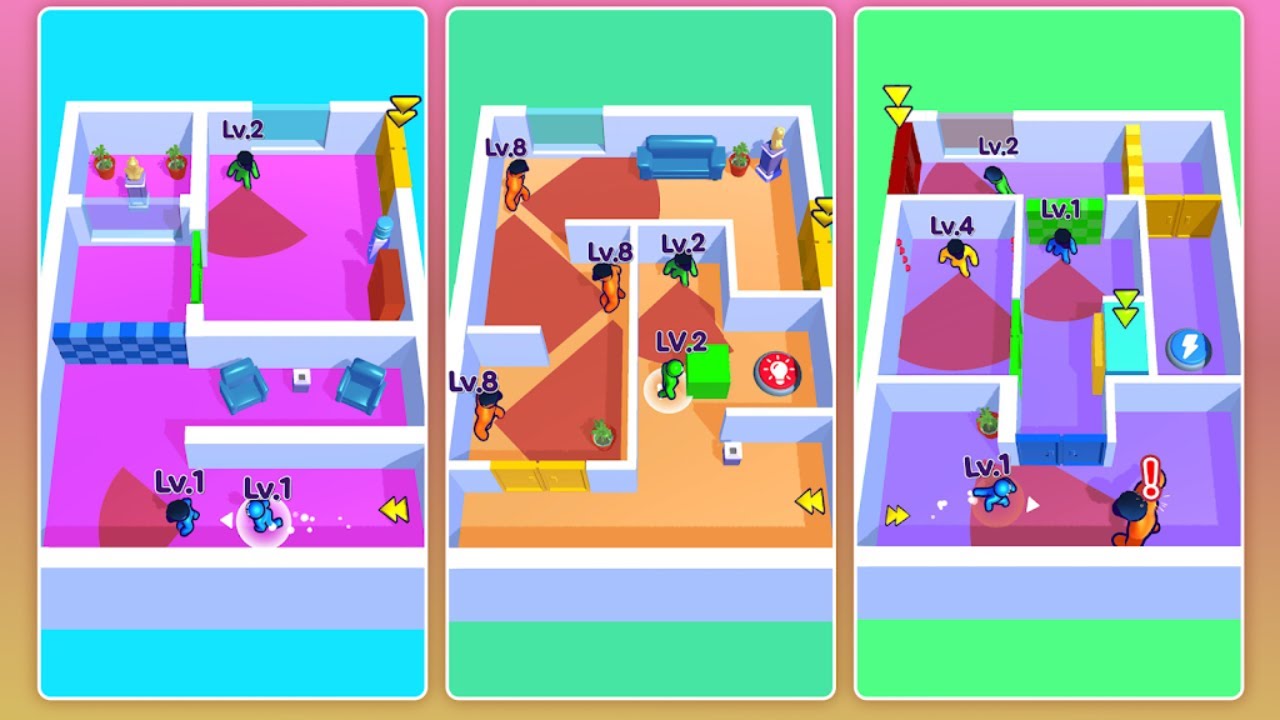
Each level is a small top-down maze that fits on one vertical screen, with a door at the start and a door at the end. Police walk set patrols with a vision cone in front, and the thief catches them from behind to merge, doubling in level and taking on a new color. Color walls, boxes, buttons, lasers, keys and lockers turn every merge into a step of the puzzle, and the exit only opens for the strongest color of the level.

Key Design Choices

  • Catch from behindMerging only works from behind, so every catch is about timing the patrol and reading the vision cone.
  • Levels that doubleEach merge doubles the thief's level and changes its color, and the thief grows bigger with every catch.
  • Color opens the wayWalls, boxes, doors and locks ask for the right color, so players pick which officer to catch next.
  • Higher ranks see moreOfficers of a higher level see farther and sometimes move faster, so the strongest catch is the hardest one.
  • Hide and waitLockers hide the thief in closed rooms, so players let the patrol pass and catch the officer from behind.
05

World & Visual Identity

A bank heist in bright, toy-like colors. The levels are blocky and clean, with clear shapes and bank details like protective glass that suggest something precious inside. Police grow bigger, more muscular and warmer in color as they get stronger, so their level reads at a glance.

Visual Principles

  • Bright and blockyStrong colors and clear shapes made for phones.
  • A bank to robBank props and protective glass around the loot.
  • Strength you can seeHats, shades, muscles and size show a cop's level.
  • Cold to warmPolice colors warm up as their level rises.
  • The studio's lineA look that fits the studio's line of games.
06

Results & Learnings

Results

  • Ten levels in a weekDesigned and built all ten levels in one week with one programmer, from the puzzles and the police routes to the art, the UI and the store assets.
  • A pipeline that lastedCreated the Unity production pipeline on my first project at 67 Bits, and it became the base of my work at the studio over the next year.
  • A test that moved onThe test demo reached 2.7K downloads on the studio's Play Store page, and the publisher took the game forward on its own stores.

Learnings

  • Juice has a nameI already designed visual feedback, but here I learned that games call it juice, and I started designing it on purpose.
  • Readable, then hardA puzzle has to be understood before it can feel hard, so level design and UX became one job, with the main solution standing out.
  • Pipeline firstBuilding the pipeline on my first studio project paid off on every game I made at the studio after it.

Media

The work, up close

Project gallery · 1
The Merging Thief gameplay
0:00 0:00

Gameplay

Roles

Roles & Responsibilities

I owned the game with the studio owner approving the art direction, coordinated the programmer and made everything outside the code.

Design & Coordination

  • Owned the project and made every game design decision
  • Coordinated the programmer on the game's systems
  • Defined the merge, the levels and the color rules
  • Worked as game designer and Unity artist at the same time

Level Design

  • Designed all ten levels and every puzzle in them
  • Placed doors, walls, boxes, buttons, lasers and lockers
  • Kept the main solution clear among other routes
  • Made each puzzle readable and still hard to solve

Police & NavMesh

  • Set up the NavMesh for every police patrol in the game
  • Set where each officer starts, walks and turns back
  • Tuned each officer's speed and vision to its level
  • Placed each patrol to set the timing of every catch

UX & UI

  • Designed the UX so every level reads at a glance
  • Added the merge indicator, a circle and arrow under the thief
  • Designed and built every screen of the game's UI
  • Kept the whole level visible on one vertical screen

Visual Direction

  • Led the visual side of the game in the studio's style
  • Designed the police to show their strength at a glance
  • Dressed the levels as a bank with protective glass
  • Built a bright, blocky look with clear shapes for phones

3D, Materials & Light

  • Modeled the characters, props and levels in 3D for Unity
  • Tested several shaders and made some of my own for the look
  • Set the materials and lighting to the approved look
  • Modeled hats, shades and muscles for stronger police

Animation & VFX

  • Animated the walk, run, jump and merge of the characters
  • Made the merge VFX, from puddle to bouncy reveal
  • Added squash and stretch and objects that fly on impact
  • Added an alert over the head of officers who spot the thief

Store, Ads & Pipeline

  • Created the store images and the icons of the game
  • Made the promotional videos the studio used for ad traffic
  • Built the Unity pipeline I followed for the next year at 67 Bits
  • Set the pipeline steps from 3D model to material and light

Full Case Study

The Merging Thief Case Study

Core Loop

  1. Read the level
  2. Avoid the vision cones
  3. Catch from behind
  4. Merge and grow
  5. Open the way

Every level starts with a read. The whole level fits on one vertical screen, so players see the police, their patrols and every barrier before they move. They slip past the vision cones and catch an officer from behind, and the thief absorbs the officer, grows and takes on a new color. That color opens the next part of the level, a wall, a box or a door that would not move before. A level ends one of two ways, at the exit door, which only opens for the strongest color of the level, or with the thief caught by the police, and then it starts over the same way.

Level Design

Feature Introduction

Ten levels, read from above

Purpose

Each level is a small top-down maze on one vertical screen, with a door at the start and a door at the end, built so the whole puzzle reads before the first move.

Design Goal

  • Show the whole puzzle on one vertical screen before the first move
  • Make every catch a matter of reading and timing the patrol
  • Keep the main solution clear while other routes still exist
  • Make the right color the key that opens every barrier

Key Areas

  1. 01 Entrance & Exit DoorsStart, Goal & the Strongest Color
  2. 02 Level DoorsMaze Structure & Progress Gates
  3. 03 Box WallsColor Gates & Catch Order
  4. 04 Push BoxesPush Puzzles & Held Buttons
  5. 05 ButtonsSwitches, Traps & Level Control
  6. 06 LasersHazards Turned into Tools
  7. 07 LockersHiding Spots & Patrol Timing
  8. 08 Keys & Locked DoorsSide Goals & Backtracking

Feature Breakdown

Readability & Visual Guidance

Feature Breakdown

Level and Structure

Impact

How a level shapes each move

  • Read First

    The whole level fits on one vertical screen, so players read the patrols, the barriers and the exit color first, and plan the order of their catches before the thief takes a single step.

  • Time the Patrol

    Officers walk set routes at set speeds, so players learn each route, wait for an officer to turn away and slip in behind it. Every catch is a question of timing and position.

  • Choose the Order

    Every barrier shows the color it asks for, so players decide which officer to catch next and which to leave for later. A catch in the wrong order means going back for another officer.

  • Hide and Wait

    Closed rooms leave no way around an officer walking toward the thief, so players hide in a locker, let the patrol walk past and step out behind it to make the catch.

  • Use the Level

    Boxes hold buttons down and rays freeze officers, so players change the level to clear their path, stepping on a blue button at the right moment to stop a patrol and walk past.

  • Find the Way

    Some puzzles have more than one way through and the main one stands out, so players always find a solution and still feel that they worked out the puzzle on their own.

Police & Merge

Feature Introduction

Catch from behind, merge, grow

[object Object],[object Object],[object Object]

Design Principles

  • Sell the fantasy of a thief who absorbs the police, with every catch making it visibly bigger, stronger and a new color
  • Make catching from behind the one rule of the merge, so every catch is a question of reading a patrol and choosing the moment to move in
  • Show an officer's strength before the catch through color, size and accessories, so players judge each catch at a glance on a small screen
  • Tie every merge to the level, with each new color opening a barrier, so the order of the catches becomes the puzzle itself

Feature Breakdown

The police, in detail

Feature Breakdown

The merge, in detail

Game Feel

Feature Introduction

A merge you can feel

[object Object],[object Object],[object Object]

Design Principles

  • Make every merge a big, clear moment that sells the fantasy of a thief absorbing the police, exaggerated enough to read on a phone
  • Give each catch a visible change, with the thief growing bigger and taking a new color as it bounces out of the puddle
  • Use squash and stretch on the characters so every walk, run, jump and merge has weight and stays readable from above
  • Make collisions loud, with boxes and objects flying far across the level when the thief runs into them

Design Iterations

Development

Development

Pipeline, Models & Materials

Conclusion

Conclusion

Design Conclusions

The Merging Thief was my first game as a Unity artist at 67 Bits and my first fixed job in the industry. In one week, with one programmer, I owned the game from the ten levels to the art, and the pipeline I built for it became the base of my work at the studio for the next year.

It also gave me a name for something I already did. My design degree had taught me visual feedback, and here I learned that games call it juice, and started designing it on purpose. The other lesson came from the levels, where readable and hard had to live in the same puzzle.

Design Takeaways

  • Feedback became a design tool

    My design degree taught me visual feedback, and here I learned that games call it juice. Knowing the name made me design it on purpose, starting with the merge.

  • Readable comes before hard

    A puzzle has to be understood before it can feel hard. Level design and UX became one job here, with the main solution standing out and players able to see how they solved it.

  • A pipeline worth repeating

    Building the pipeline on my first studio project paid off on every game I made at 67 Bits after it, since the next year of work followed the steps I set up for this one.

Next project

Flip Phone